





If someone sues you after a car accident, your first step is to get the lawsuit papers into the right legal hands so that you can start building a strong defense. When you have auto insurance, the lawsuit is usually handled through your policy, not paid directly out of your pocket.
In most Texas policies, the insurer has a duty to defend you, which means they hire and pay a defense lawyer, handle court deadlines, and manage negotiations up to your policy limits. You typically only need your own separate attorney if the potential damages are far above your coverage or your insurer is trying to deny or limit protection.
If your insurance company has denied the claim, sent a reservation of rights letter, or you were also injured and may need to bring your own injury claim, it is time to involve a Fort Worth, TX car accident lawyer. Stephens Law can review the lawsuit, your policy, and the facts of the crash and help you decide on your next move.
Key Takeaways if Someone Sues You After a Car Accident in Texas
- Contact your insurer immediately so they can trigger the duty to defend under your Texas auto policy and assign a defense lawyer.
- Your insurance usually pays for your defense lawyer up to your policy limits; you may only need separate counsel if damages exceed your coverage or the carrier denies coverage.
- Most Texas car accident lawsuits settle within policy limits rather than going to trial, so your personal assets are rarely at risk.
Step One: Hand the Papers to Your Insurance Company
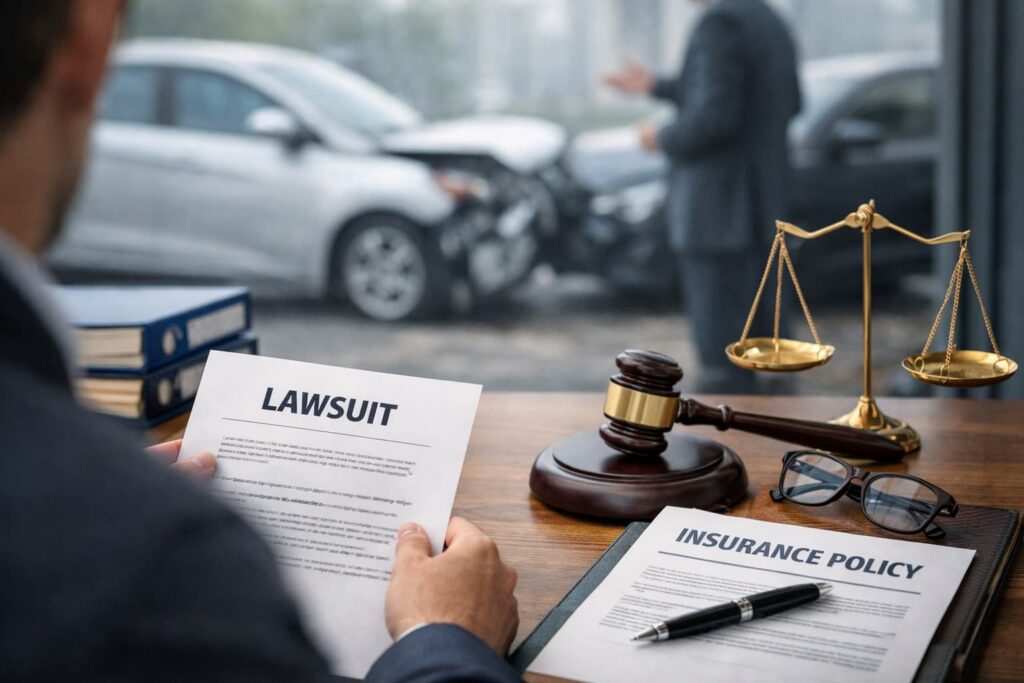
When you receive the lawsuit, legally called a Petition in Texas, a clock starts ticking immediately.
Under Texas law, you generally must file a formal written Answer with the court by 10:00 a.m. on the Monday next following the expiration of 20 days after you were served. This is a strict deadline. If you miss it, the plaintiff (the person suing you) can ask the court for a default judgment.
A default judgment means you lose automatically. The judge assumes everything the plaintiff claimed is true because you didn’t show up to argue otherwise. Thus, you could be on the hook for the full amount they asked for, regardless of what actually happened in the accident.
The Duty to Notify
Most insurance contracts have a notice provision. This clause states that you might void your coverage if you fail to tell your insurer about the lawsuit immediately. If the insurance company doesn’t know about the suit, they cannot defend you.
If you wait until the 19th day to tell them, or if you ignore it until a default judgment is entered, the insurance company may argue that your delay prejudiced their ability to defend the case. They could deny coverage entirely, leaving you to pay the judgment out of your own pocket.
How to Handle the Hand-Off
Do not rely on snail mail. The process needs to be immediate and verifiable:
- Call your claims adjuster: If you already have a claim open from the accident, contact the adjuster assigned to it.
- Scan and Email: Send the full PDF of every page you received to the adjuster.
- Confirm Receipt: Ask for a written confirmation, like an email reply, stating they have received the lawsuit and are assigning counsel.
Once this is done, the insurer assigns a defense attorney. While the insurance company pays this lawyer, this attorney represents you. Their ethical duty is to protect your interests in court.
Will I Lose My House? Understanding Liability and Policy Limits
The primary fear most people have when they see a lawsuit is financial ruin. You see a demand for $1 million and look at your bank account, knowing the math doesn’t work.
Here’s what actually happens: your insurance policy is the first line of defense. The vast majority of car accident lawsuits settle within the insurance policy limits.
The Gap Between Demand and Reality
Just because a lawsuit asks for a specific amount doesn’t mean a jury will award it. Plaintiffs’ attorneys typically start with a high number to leave room for negotiation.
Furthermore, attorneys know that collecting money from an individual is difficult. If they get a judgment against you for $50,000 more than your insurance covers, they have to spend time and money trying to find your assets, garnish bank accounts (which is limited in Texas), or place liens.
Because of this difficulty, most plaintiffs eventually agree to settle for the insurance policy limits—or a number within them—rather than chasing you personally for the excess.
Texas Homestead Protections
If you own your home, Texas has some of the strongest homestead protections in the United States. In many judgment scenarios, creditors cannot force you to sell your primary residence to pay off a civil debt like a car accident judgment.
However, if the damages are catastrophic and you have significant assets other than your home, you might have exposure. This is known as an excess judgment risk.
When to Pay Attention
If the lawsuit demands an amount that exceeds your coverage, your insurance-appointed lawyer should send you a letter warning you of this excess exposure.
In this specific scenario, we advise consulting with a separate personal attorney to monitor the case and ensure the insurance company is making a good-faith effort to settle the claim within your limits to protect you.
How Texas Comparative Fault Laws Protect You
Being sued does not mean you are automatically liable. The plaintiff has the burden of proof. They must convince a jury that you were negligent and that your negligence caused their injuries.
Even if you made a mistake, you might not be 100% to blame. Texas operates under a legal standard called proportionate responsibility, found in Chapter 33 of the Texas Civil Practice and Remedies Code.
The 51% Bar Rule
This is the most significant rule in your defense. In Texas, a plaintiff cannot recover damages if they are more than 50% responsible for the accident.
If the jury finds you 100% at fault, the plaintiff gets 100% of their damages. If the jury finds the plaintiff partially at fault but less than 51%, their award is reduced by that percentage. If the jury finds the plaintiff 51% or more at fault, they receive zero dollars.
The Defense Strategy
Your defense lawyer doesn’t necessarily need to prove you did nothing wrong. Their strategy is frequently to introduce evidence that shifts percentage points of fault onto the other driver.
For example, you may have turned left when you shouldn’t have, but perhaps the other driver was speeding or texting. If the defense can prove the other driver’s actions contributed significantly to the crash, it reduces the amount the insurance company has to pay. If they can shift the majority of the blame to the plaintiff, the case goes away entirely.
The Lawsuit Process: What to Expect From Home
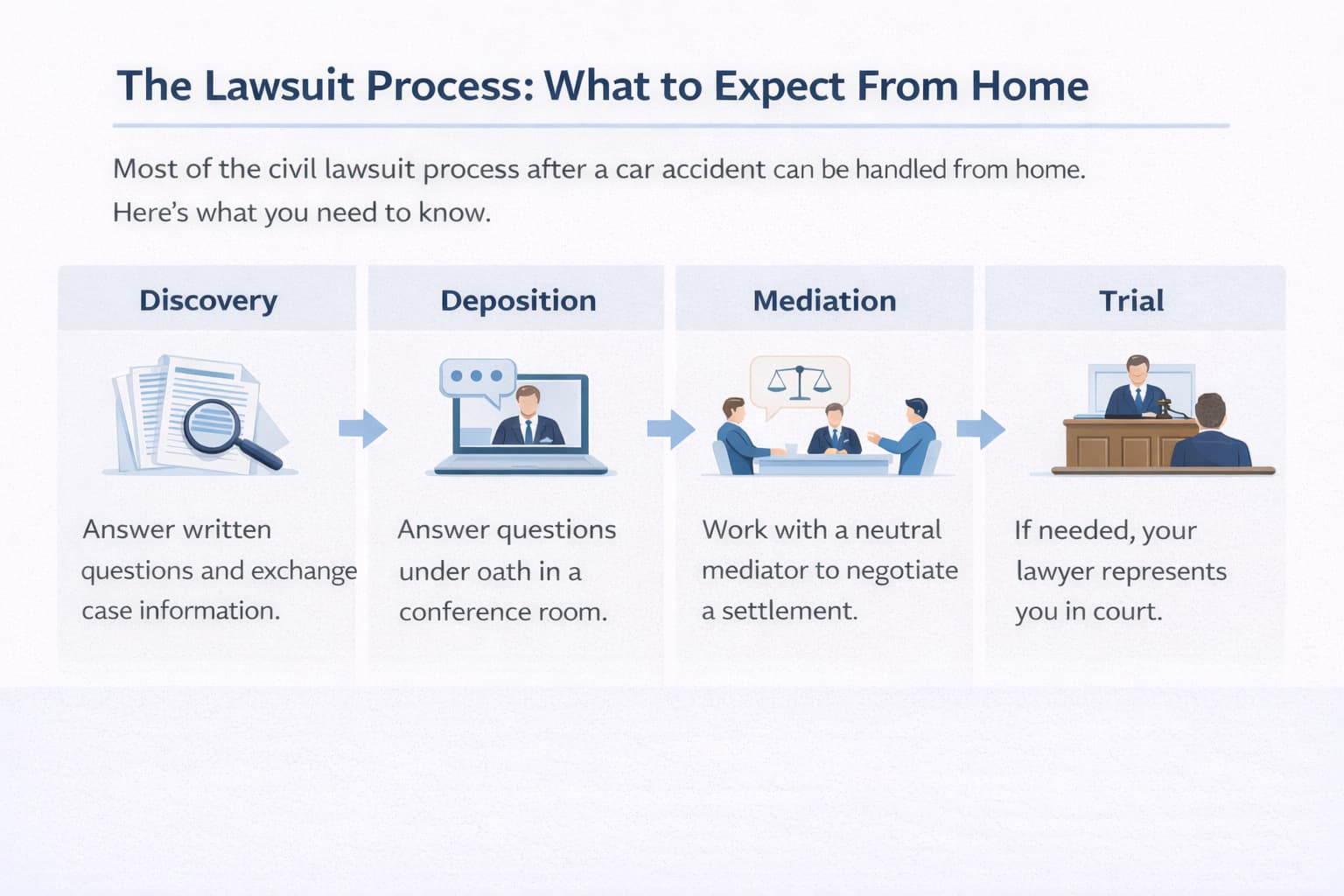
The civil lawsuit process after a car accident usually moves slowly and in stages, most of which you experience from home rather than in a courtroom. You will likely go through some or all of the following steps:
- Discovery: This is the longest phase, when the lawyers exchange information. You answer written questions about the crash, your background, and your insurance, and provide documents your defense lawyer helps you prepare.
- Deposition: You answer questions under oath in a conference room, not a courtroom. The plaintiff’s lawyer asks you about what happened while your lawyer sits beside you and prepares you to be honest, concise, and consistent.
- Mediation: Most Texas courts require mediation before trial. You, your lawyer, the adjuster, and the other side work with a neutral mediator who goes back and forth between rooms to see if everyone can agree on a settlement number.
- Trial: Only a small percentage of personal injury cases ever reach a verdict. If yours does, you must attend, but your lawyer handles jury selection, legal arguments, and questioning witnesses while you testify when needed.
For most people, that means staying in close contact with your lawyer, responding to requests for information, and letting the legal team handle the technical work.
Common Scenarios: Why Am I Being Sued?
Here are the three most common reasons a lawsuit is filed.
Scenario A: Disputed Liability
The insurance companies couldn’t agree on what happened. Your insurer says you were right; the other driver’s insurer says they were right. When adjusters reach a stalemate, the only way to break the deadlock is to file a lawsuit and let a jury or a settlement judge decide who caused the crash.
Scenario B: Damages Disagreement
Your insurer might admit you were at fault but disagree on the price tag. For example, if you tapped someone’s bumper at 5 mph and they are claiming they need a $100,000 back surgery, your insurance company will refuse to pay that amount.
The lawsuit is the mechanism used to determine the fair market value of the injury. The defense lawyer will hire medical experts to review the records and determine if the surgery was actually related to the accident or a pre-existing condition.
Scenario C: Protecting the Statute of Limitations
In Texas, an injured person generally has two years from the date of the accident to settle their claim or file a lawsuit. This is the statute of limitations.
Sometimes, negotiations run slow. If the two-year mark is approaching and the insurance company hasn’t cut a check, the plaintiff’s lawyer must file a lawsuit to keep the claim alive. They might still intend to settle out of court, but they have to file the paperwork to stop the clock.
What If I Was Uninsured at the Time of the Accident?
If you did not have a valid insurance policy when the accident happened, the situation is much more serious. You do not have a duty to defend clause protecting you, meaning no insurance company will pay for a lawyer.
You are personally liable for your own legal defense costs and any judgment entered against you. If you ignore the lawsuit, a default judgment will be entered, and the plaintiff can begin collection actions against you immediately.
We recommend consulting with a defense attorney or a bankruptcy attorney immediately to assess your asset exposure.
Furthermore, under the Texas Safety Responsibility Act, an unpaid judgment regarding a car accident can lead to the suspension of your Texas driver’s license and vehicle registration. The state will not reinstate your driving privileges until you satisfy the judgment or set up a court-approved installment plan.
FAQs for Being Sued After a Car Accident
Can the other driver take my paycheck if I lose?
Texas has very strict laws regarding wage garnishment. For consumer debts and civil judgments, like those from a car accident, Texas generally does not allow creditors to garnish your current wages. They can garnish bank accounts once the money is deposited, but they cannot take the money directly from your employer before you see it, with exceptions for child support, taxes, and student loans.
What if the accident was years ago?
In Texas, the general statute of limitations for personal injury is two years. If the lawsuit is filed more than two years after the crash, your lawyer can likely file a motion for summary judgment to have the case thrown out immediately. There are rare exceptions, such as if the plaintiff was a minor at the time, but generally, the two-year rule is strict.
I wasn’t driving, but I own the car. Why am I being sued?
You can be sued for negligent entrustment. This occurs if you lent your vehicle to someone you knew or should have known was an incompetent, unlicensed, or reckless driver. However, mere ownership usually isn’t enough to make you liable; the plaintiff must prove you were negligent in lending the car.
Can I countersue them if I was hurt too?
Yes, and in fact, you typically must. In Texas, if your claim arises out of the same transaction or occurrence as the plaintiff’s claim, it is considered a compulsory counterclaim. If you do not bring your injury claim within the same lawsuit, you might lose the right to do so later. If you were injured, speak to a personal injury attorney immediately.
You Have Rights After a Car Accident. Make Sure They Are Protected With the Help of Stephens Law.
Being served with legal papers is stressful, but it is a structured part of the civil justice system. You pay for insurance specifically for this moment. Once you notify your carrier, professionals step in to handle the burden of proof, the negotiations, and the legal arguments.
The system works when you participate, but it punishes those who delay. Do not ignore the mail. Get the documents to your adjuster and let them do the job you pay them for.
If you believe your insurance company is acting in bad faith, refusing to defend you, or if you need to file a counterclaim for your own injuries, call Stephens Law today. Our Fort Worth personal injury attorneys will listen to your story and help you understand your legal options.