



Stephens Law Firm | November 3, 2025 | Truck Accidents
Sharing Texas highways with 80,000-pound commercial trucks requires a great deal of trust. We count on truck drivers to be focused, skilled, and alert every moment they are behind the wheel.
When that trust is broken, the results can be catastrophic. Many devastating collisions are entirely preventable, often stemming from the specific ways truck drivers cause accidents through negligence or poor judgment. These preventable errors directly determine who can be held accountable for the resulting injuries and losses.
Key takeaways
- The most frequent causes of truck accidents are preventable human errors, including distraction, fatigue, speeding, impairment, and inadequate vehicle inspections. These actions violate federal safety regulations and basic duties of care.
- Federal Motor Carrier Safety Administration (FMCSA) regulations create strict rules for operators, including Hours-of-Service limits to prevent fatigue and zero-tolerance policies for substance use. Violations are often a key element in proving negligence.
- Evidence from the truck’s electronic logging device (ELD) or “black box” is crucial. It provides objective data on speed, braking, and hours of service that can directly contradict a driver’s story.
- While a driver’s actions may be the direct cause of a crash, the trucking company is often liable. This liability can stem from negligent hiring, inadequate training, poor maintenance protocols, or pressure on drivers to meet unrealistic deadlines.
- A thorough investigation is essential to uncover all contributing factors. A truck accident attorney can help preserve evidence, consult with experts, and build a case that identifies every party whose negligence led to the accident.
The Pervasive Danger of Distracted Driving
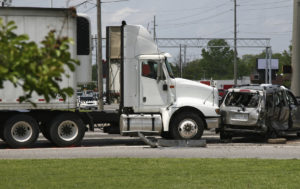
A distracted driver of any vehicle is a hazard. A distracted commercial truck driver is a lethal threat. The sheer size and weight of a semi-truck mean that even a few seconds of inattention can have irreversible consequences. A truck traveling at highway speed covers the length of a football field in under five seconds, leaving no time to react to a sudden stop or obstacle.
Types of driver distraction: cognitive, visual, and manual
Driver distraction is not just about texting. It encompasses any activity that diverts a driver’s focus from the road. These distractions fall into three main categories, and many dangerous activities, like using a phone, involve all three simultaneously.
- Visual distractions: These are actions that cause a driver to take their eyes off the road, such as looking at a GPS device, paperwork, or something on the roadside.
- Manual distractions: These involve a driver taking their hands off the steering wheel to do something else, like eating, drinking, or adjusting controls in the cab.
- Cognitive distractions: This is the mental distraction that occurs when a driver’s mind is not focused on driving. A driver might be lost in thought or engaged in a difficult conversation.
Any one of these distractions can be enough to cause a serious crash. When combined, the risk becomes exponentially higher for everyone on the road.
Federal Rules Targeting Distracted Commercial Drivers
The Federal Motor Carrier Safety Administration (FMCSA) recognizes the extreme danger of distracted driving in commercial vehicles. The agency has implemented specific rules to combat this behavior.
For example, federal regulations expressly forbid commercial drivers from texting or using handheld mobile phones while operating their vehicles.
Uncovering evidence of distraction after a crash
Proving a driver was distracted requires a prompt and thorough investigation. Evidence may come from various sources, including the driver’s own cell phone records, which can show call, text, or data usage at the moment of impact.
Eyewitness testimony, dashcam footage, and data from in-cab monitoring systems can also be powerful tools for establishing negligence.
Driver Fatigue: A Preventable Catastrophe
A drowsy driver can be just as impaired as one who is under the influence of alcohol. Fatigue slows reaction time, clouds judgment, and can lead to a driver falling asleep at the wheel. In the trucking industry, long hours and demanding schedules make driver fatigue a persistent and deadly problem.
Understanding Federal Hours-of-Service (HOS) Regulations
To fight the dangers of drowsy driving, the FMCSA enforces strict Hours-of-Service (HOS) regulations. These rules clearly define the maximum number of hours a commercial driver can be on duty and behind the wheel in a given period.
They also mandate minimum off-duty rest periods to ensure drivers are properly rested before getting back on the road.
Why drivers violate hos rules
Despite these clear rules, violations are common. Some drivers may feel pressured by their employers to meet unrealistic delivery schedules, leading them to push past their legal limits.
Others may falsify their logbooks to hide violations. While the job is demanding, there is no excuse for operating an 80,000-pound vehicle while exhausted.
Using electronic logs to prove fatigued driving
For years, drivers used paper logs, which were easy to alter. Now, most commercial trucks are equipped with Electronic Logging Devices (ELDs). These devices connect directly to the truck’s engine and automatically record driving time, providing an objective and reliable record of a driver’s activity.
This data is invaluable in a personal injury claim, as it can definitively prove when a driver violated HOS regulations.
The Destructive Force of Speeding and Aggressive Driving
The immense weight of a fully loaded semi-truck means it requires a much greater distance to stop than a passenger vehicle. When a truck driver speeds, they eliminate the safety cushion needed to avoid a collision. This decision turns their vehicle into an uncontrollable force, and the consequences are often tragic.
The National Safety Council reported that in 2020, speed was a factor in 29% of all traffic fatalities.
The physics of a speeding commercial truck
A speeding truck builds a tremendous amount of momentum. If a hazard appears on the road ahead, the driver simply does not have the time or distance needed to bring the vehicle to a safe stop.
This is a primary reason why Texas Transportation Code § 545.351 requires all drivers to operate at a speed that is “reasonable and prudent” for the current conditions, regardless of the posted speed limit.
Aggressive maneuvers that endanger everyone
Speeding is often accompanied by other aggressive driving behaviors that increase the risk of a crash. These dangerous actions show a clear disregard for the safety of others.
Common aggressive driving tactics include:
- Following other vehicles too closely (tailgating).
- Making frequent or unsafe lane changes without signaling.
- Failing to account for the truck’s large blind spots.
- Intimidating other drivers on the road.
These actions are not just discourteous; they are negligent and frequently lead to devastating multi-vehicle pileups. An experienced attorney can use accident reconstruction experts to analyze skid marks and debris fields to prove this type of reckless behavior occurred.
The challenge of navigating texas highways and interstates
Major Texas corridors, like I-35W through Fort Worth, are congested with a mix of commercial trucks and passenger vehicles. Navigating this heavy traffic safely requires patience and skill. An aggressive or speeding truck driver in these conditions creates an unacceptable risk for every family on the road.
Driving Under the Influence of Drugs or Alcohol (DUI)

While less common than other causes, impaired driving remains a significant factor in serious truck accidents. The use of alcohol, illegal drugs, or even certain prescription medications can severely compromise a driver’s ability to operate their vehicle safely.
The FMCSA has a zero-tolerance policy for substance use among commercial drivers.
Stricter BAC limits for commercial drivers
For operators of commercial motor vehicles, the legal blood alcohol concentration (BAC) limit is not the .08% standard for other drivers. Under federal law, a commercial driver is considered to be under the influence with a BAC of .04% or higher.
Furthermore, they are prohibited from consuming any alcohol within four hours of going on duty.
The hidden danger of prescription and over-the-counter drugs
Impairment is not limited to alcohol or illegal substances. Many common prescription and over-the-counter medications can cause drowsiness, dizziness, and other side effects that make driving unsafe.
A driver has a professional responsibility to understand how their medications may affect them and to avoid driving if they are impaired.
Post-accident and random drug testing
Federal regulations mandate drug and alcohol testing for commercial drivers in several situations, including after a fatal accident or an injury accident that results in a citation.
Trucking companies are also required to conduct random testing programs. The results of these tests can serve as direct evidence of impairment in a personal injury claim.
Failure to Conduct Proper Inspections and Maintenance
A commercial truck is a complex machine with thousands of moving parts that must be in safe working order. Both the driver and the trucking company have a legal duty to ensure the vehicle is properly maintained and inspected.
A failure in this duty can lead to catastrophic equipment failure on the highway.
The non-negotiable pre-trip inspection
Drivers are required by law to conduct a thorough pre-trip inspection before every shift. This inspection involves checking key safety components to ensure they are functioning correctly.
Skipping this crucial step or performing a lazy check is a form of negligence that can have deadly consequences.
Common equipment failures from negligent maintenance
When maintenance is neglected, critical components can fail without warning. A detailed post-accident inspection of the truck can reveal whether an equipment failure contributed to the crash.
Some of the most dangerous mechanical failures include:
- Worn-out or improperly inflated tires that lead to a blowout.
- Brakes that are out of adjustment or have worn linings.
- Malfunctioning headlights, taillights, or turn signals.
- Defective steering or suspension components.
- Broken or missing reflective tape needed for visibility.
These failures are almost always preventable with a proper maintenance and inspection schedule. Identifying them is key to holding both the driver and the trucking company accountable for their negligence.
FAQ for Accidents Caused by Truck Drivers
What should I do if I suspect a truck driver is behaving dangerously on the road?
Your safety is the top priority. Create as much distance as possible between your vehicle and the truck. If you can do so safely, pull over and report the truck’s location, license plate number, and the company name on the vehicle to law enforcement by calling 911. Do not attempt to confront the driver yourself.
Can a truck driver be at fault even if they didn’t directly hit my car?
Yes. A truck driver can cause an accident without making physical contact. For example, if a driver makes an improper lane change and forces you off the road or into another vehicle to avoid a collision, they may still be held legally responsible for your injuries and damages. This is sometimes called a “no-contact” accident.
How do you determine if the driver or the trucking company is at fault?
In many cases, both the driver and the company share responsibility. The driver is responsible for their direct actions, while the company may be liable for negligent hiring, inadequate training, or pressuring the driver to violate safety rules. A thorough investigation is needed to identify all liable parties.
Why is it so important to contact an attorney quickly after a truck accident?
Acting quickly is crucial because evidence can disappear. Trucking companies may repair the truck, and electronic data can be overwritten. An attorney can send a spoliation letter immediately to legally demand that the company preserve all relevant evidence, including the truck itself and all electronic data, for inspection and review.
Get the Help Your Family Needs

When a truck driver’s carelessness causes serious harm, you have the right to seek answers and accountability. The legal process can be overwhelming, but you do not have to navigate it alone.
The team at Stephens Law understands the profound challenges you are facing and is here to provide the guidance and support you need. We are in Fort Worth and proudly serve clients throughout Texas.
Call us today at 817-420-7000 to schedule a free, no-obligation consultation.