



Stephens Law Firm | March 6, 2026 | Car Accidents
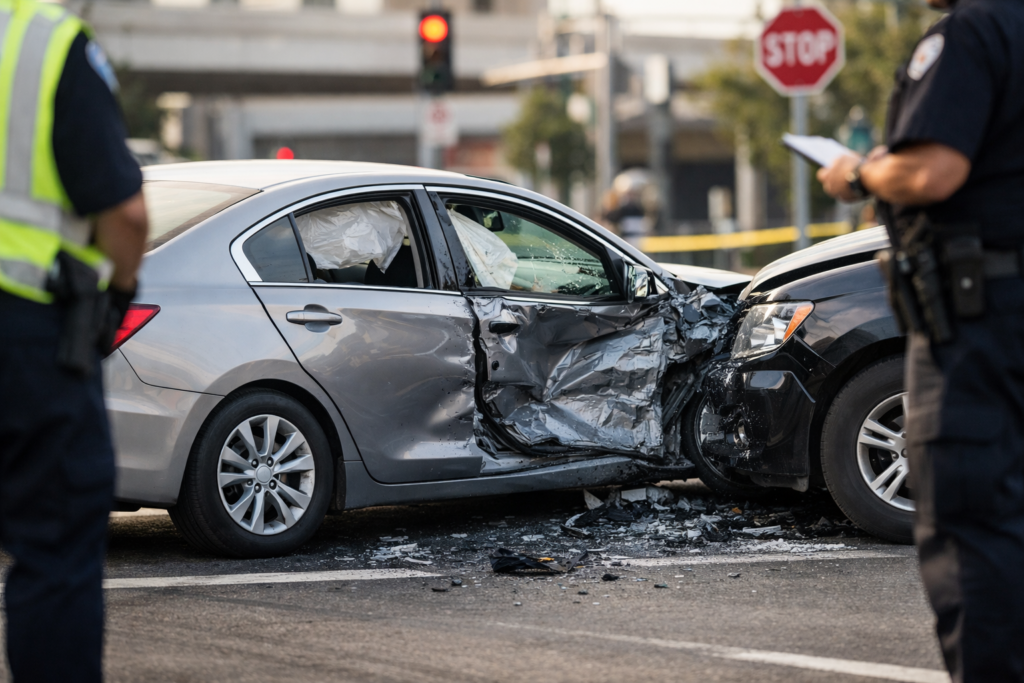
Side-impact collisions, commonly called T-bone accidents, are so dangerous because they strike the most vulnerable part of your vehicle: the doors. Unlike a rear-end collision where feet of steel and crumple zones absorb the impact, a T-bone crash leaves only a few inches of material between you and the striking vehicle.
The physical danger is only half the problem, because the legal danger is just as real. T-bone accidents almost always occur at intersections, creating an immediate he-said-she-said scenario. Both drivers typically claim they had the green light or the right of way.
Because Texas operates under a modified comparative negligence standard, proving you had the right of way determines if you get paid at all. If the insurance company can shift 51% of the blame onto you, your compensation drops to zero.
If you or a family member were injured in a side-impact crash and the insurance company is disputing who had the right of way, a Fort Worth, Texas car accident lawyer can help gather and present strong evidence supporting your claim for maximum compensation.
Key Takeaways About Why T-Bone Accidents Are So Dangerous
- Fault is almost always disputed at intersections. Without independent witnesses or video evidence, the case becomes your word against theirs, and insurance adjusters might use this ambiguity to deny your claim.
- Vehicle doors offer minimal protection against impact. Unlike head-on or rear-end crashes, side impacts often bypass the vehicle’s main crumple zones, frequently resulting in severe intrusion and direct trauma to the driver or passenger.
- Evidence disappears within days. Security cameras at intersections often overwrite footage every 48 to 72 hours, so early legal intervention is critical to preserving strong evidence that can support your case.
The Physics of the Crash: Why the Injuries Are So Severe
The Lack of Crumple Zones
The front of your car is designed to fold like an accordion. When you hit something head-on, the hood buckles, the engine drops, and the frame absorbs a massive amount of kinetic energy before it ever reaches the driver’s seat. This is called a crumple zone.
The side of your car does not have this luxury. It relies almost entirely on the B-pillar (the vertical post between the front and back doors) and the door beam. When another car slams into your door, there is very little space to absorb that energy.
This leads to intrusion—when the striking vehicle pushes the door structure into the cabin, physically crushing the occupant. The space you occupy suddenly becomes smaller than your body.
Direct Energy Transfer
The direction of force matters immensely. In a rear-end crash, your seatback supports your spine. In a T-bone, your body is thrown laterally. We are not built to move that way violently.
When you are hit from the side, your head frequently strikes the window or the B-pillar before the side-curtain airbag (if your car has one) can fully mitigate the force. The shock is delivered directly to the side of your body, bypassing many of the vehicle’s primary safety systems.
The Mismatch Problem
This issue is compounded by the types of vehicles on Texas roads. We have a high density of large pickup trucks and SUVs. According to the IIHS, side-impact crashes account for nearly a quarter of passenger vehicle occupant deaths.
When a higher-riding vehicle, like a Ford F-150, hits a standard sedan, like a Honda Civic, the bumper of the truck typically bypasses the sedan’s reinforced rocker panel. Instead of hitting the strong frame at the bottom of the car, the truck strikes directly at the occupant’s head or chest level. This mismatch results in catastrophic injuries even at moderate speeds.
How Texas Right-of-Way Laws Apply to Your T-Bone Case
Legally speaking, most T-bone accidents stem from a failure to yield right-of-way. While this sounds simple, proving it in a claim is tricky. Texas law has specific statutes governing intersections that insurance adjusters will use to evaluate your liability.
The Legal Definition of a T-Bone
Under Texas Transportation Code Chapter 545, drivers must yield in specific scenarios. If a driver fails to do so and causes a crash, they are liable. But the “green light” defense doesn’t always hold up.
Left-Turn Scenarios and Imminent Hazards
One of the most common T-bone scenarios involves a driver turning left on a solid green light (not a green arrow). Many drivers believe that because the light is green, they have the right to turn. This is incorrect.
The law requires a driver turning left to yield to oncoming traffic that is close enough to constitute an “immediate hazard.” If you turn left and get T-boned by an oncoming car, the presumption of fault usually rests on you.
However, this is rebuttable. If we can prove the oncoming car was speeding excessively, they may have created a hazard that you could not have reasonably judged.
Red Light Runners and Negligence Per Se
The classic intersection crash involves someone running a red light. In legal terms, this can be classified as negligence per se. This legal concept simplifies the burden of proof. It simply means that if a person violates a safety statute (like running a red light) and hurts someone, the law automatically considers them negligent.
We do not have to prove a “reasonable person” would have stopped. We only have to prove the light was red.
Four-Way Stops
Confusion reigns at four-way stops. The rules are clear: whoever arrives first goes first. If two cars arrive simultaneously, the driver on the right has the right of way.
In reality, drivers frequently operate on hesitation and aggression. Proving who arrived a split-second earlier is difficult without independent witnesses or video evidence.
The He-Said-She-Said Trap: Comparative Negligence in Texas
How the System Works
Texas operates under a rule called modified comparative negligence, also called the 51% Bar Rule.
It works like this: The court (or the insurance adjuster during settlement talks) assigns a percentage of fault to everyone involved.
- If you are 0% at fault, you get 100% of your damages.
- If you are 20% at fault, your payout is reduced by that percentage.
- If you are 51% or more at fault, you recover zero.
The Insurance Strategy
Insurance adjusters are not out to get you personally; they are professionals managing a business. Their goal is to accurately assess liability, but they will look for any evidence that mitigates their exposure. They know the comparative negligence laws intimately.
Consequently, they do not necessarily need to prove their driver was innocent. They just need to argue that you were mostly at fault.
Consider a scenario where you entered an intersection as the light turned yellow. The other driver turned left in front of you, causing a T-bone. The other driver is likely at fault for failing to yield. However, the insurer might argue you were speeding to beat the light. If they can convince a jury that your speeding was the primary cause of the crash (51%), they pay nothing.
Why Witnesses Disappear
The biggest challenge in intersection crashes is the lack of staying power. When a crash happens on a highway, traffic stops. At an intersection, once the light changes, other drivers, who are your potential witnesses, usually drive away immediately.
You are left alone, injured, with no one to verify that you had the green light.
Common Injuries and Long-Term Latency
Because of the physics described earlier, the injuries in T-bone accidents are distinct from other crashes. They are typically more severe and, dangerously, can be slower to present symptoms.
Torso and Rib Injuries
The side impact directly assaults the rib cage. For drivers struck on the left side, this results in broken ribs, a punctured lung, or damage to the spleen in many cases. These are not always immediately obvious amidst the adrenaline of the crash, but they can be life-threatening if internal bleeding goes undetected.
Traumatic Brain Injuries (TBI)
The lateral movement of the head is particularly dangerous for the brain. In a T-bone, the head whips sideways, causing the brain to strike the inside of the skull. This is known as a coup-contrecoup injury.
Symptoms of a Traumatic Brain Injury generally do not appear immediately. You might feel fine at the scene, only to experience brain fog, mood changes, vision issues, or severe headaches days later. Insurance companies view gaps in medical treatment with skepticism, which is why you must get immediate medical attention regardless of how you feel.
Spinal Shearing
Seatbelts are designed to hold the pelvis and chest back. In a side impact, the pelvis stays put, but the upper body and neck are thrown sideways. This creates a shearing force on the vertebrae. It can lead to herniated discs or nerve damage that standard X-rays at the ER might miss. MRI scans are required in many cases to reveal the true extent of this soft tissue damage.
Evidence We Use to Prove the Other Driver Was At Fault
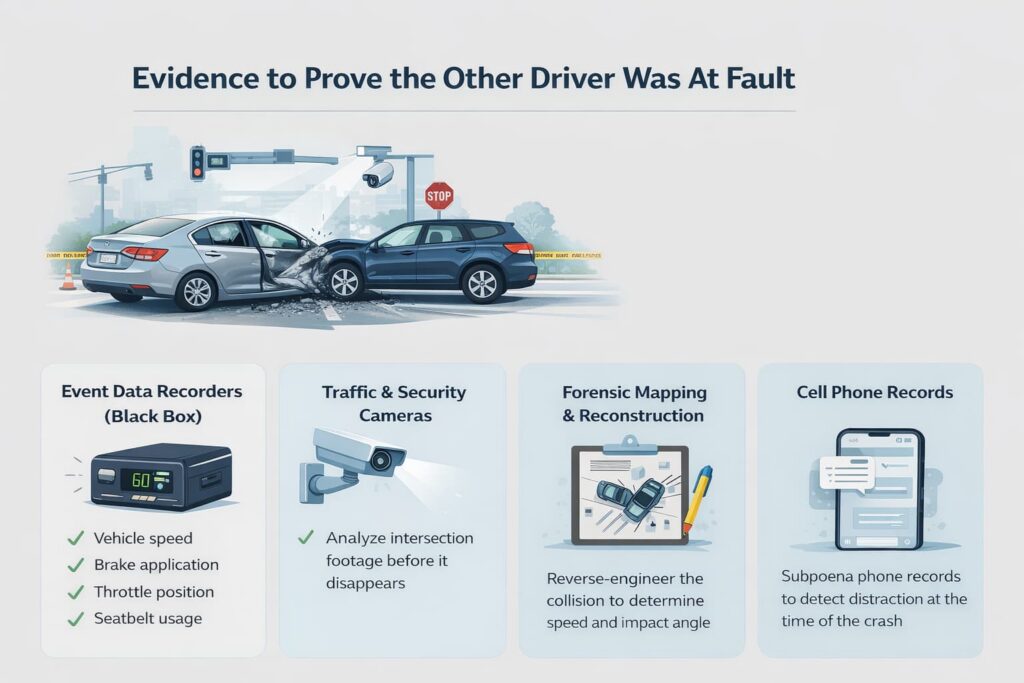
Since witnesses usually disappear and drivers lie, we rely on objective data to build your case. Physics and digital footprints are much harder to dispute.
Event Data Recorders (Black Box)
Almost every modern vehicle is equipped with an Event Data Recorder (EDR). This device records data from the vehicle’s sensors in the few seconds leading up to a crash.
It can tell us:
- Vehicle speed
- Brake application (or lack thereof)
- Throttle position
- Seatbelt usage
If the other driver claims they were going the speed limit, but the EDR data shows they were traveling 60mph in a 40mph zone, their credibility evaporates.
Traffic and Security Cameras
Texas intersections are increasingly monitored, even if red-light cameras for ticketing purposes have been restricted. Furthermore, businesses on the corner, such as gas stations, banks, and convenience stores, frequently have high-quality surveillance systems pointed at the road.
However, there is a catch: most of these systems overwrite their footage every 48 to 72 hours. We move quickly to send preservation letters to these businesses to secure the footage before it is deleted.
Forensic Mapping and Reconstruction
We work with accident reconstructionists who use the physical evidence to reverse-engineer the crash. By analyzing the crush depth (how far the metal bent) and the skid marks on the road, we can mathematically determine the speed and angle of impact. Physics generally doesn’t lie, even if the other driver does.
Cell Phone Records
Distraction is a leading cause of intersection crashes. We can subpoena cell phone records to see if the other driver was sending a text or using data at the exact moment of impact. This can be the tipping point in proving negligence.
Locally Relevant Hazards: Texas Infrastructure Issues
Driving in Texas presents unique challenges that contribute to T-bone accidents. Specifically, our reliance on feeder roads (frontage roads) and Texas U-turns creates high-risk intersection points.
Out-of-state drivers often misunderstand the yielding rules on feeder roads, leading to dangerous turns across traffic. Furthermore, Texas vegetation grows quickly. We have handled cases where stop signs or oncoming traffic were obscured by overgrown landscaping or poorly placed construction signage.
If a government entity is responsible for an obstructed view or a malfunctioning traffic light, you may have a claim under the Texas Tort Claims Act. However, be aware that the notice deadlines for claims against the government are significantly shorter than standard injury claims—in some Texas jurisdictions, notice may be due in as little as 90 days.
FAQs for Texas T-Bone Accidents
What if the other driver hit me, but I was speeding?
You can likely still claim damages, provided your speeding wasn’t the primary cause of the accident (meaning you were less than 51% at fault). However, your final compensation will be reduced by your percentage of fault. If the jury awards you a set amount but finds you 20% at fault, you will receive 80% of that award.
The other driver’s insurance called and asked for a recorded statement. Should I give one?
No. You should generally decline to give a recorded statement until you have legal counsel. Adjusters are trained to ask questions in a way that can produce soundbites they can use against you later. They might get you to inadvertently minimize your injuries or admit to not seeing the other car.
Can I sue the city if a broken traffic light caused the T-bone?
Potentially, but these are difficult cases. You must prove the city knew about the defect (or should have known) and failed to fix it within a reasonable time. These claims have strict procedural hurdles and very short deadlines.
My airbags didn’t go off in the side impact. Is that a defect?
It depends on where the sensors were hit and the severity of the crash. Airbags are designed to deploy only under specific parameters. However, if they should have deployed and failed, causing your injuries to be worse, you might have a product liability case against the manufacturer in addition to the claim against the other driver.
How do I pay for a lawyer if I’m out of work?
Our practice operates on a contingency fee basis. This means we advance the costs of the investigation, filing fees, and expert witnesses. We only get paid a percentage of the settlement or verdict we recover for you. If we don’t win your case, you don’t owe us attorney fees.
We Don’t Let Guesswork Determine Your Future
At Stephens Law, we use objective data to clear the noise and prove exactly what happened. You focus on healing from your injuries; we will handle the adjusters, the paperwork, and the legal arguments.
Call Stephens Law today to speak with a Fort Worth personal injury lawyer. We will preserve the evidence before it disappears and give you an honest assessment of your case. You have rights, but you need to act quickly to protect them.